
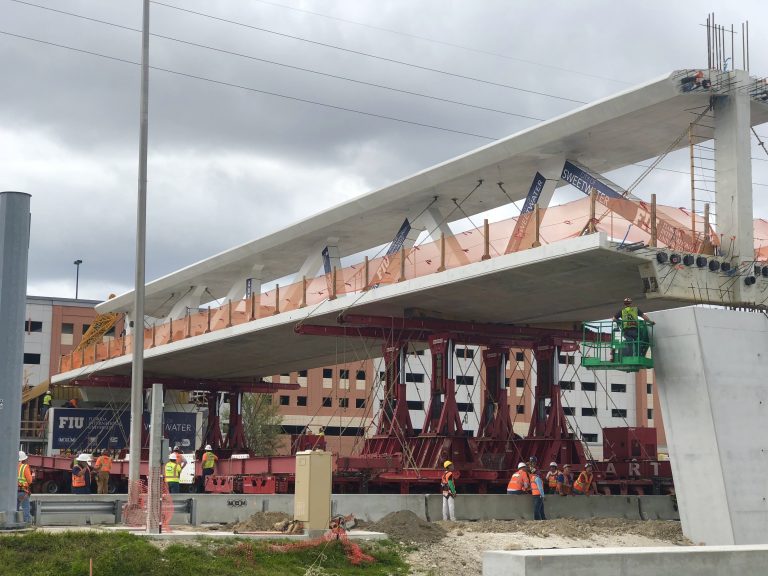
Florida International University's FIU-Sweetwater UniversityCity Bridge, which collapsed Thursday and killed at least six people, was a heavily hyped Department of Transportation-funded project using "sustainable" materials and unorthodox engineering.
The bridge was designed at the university's Accelerated Bridge Construction University Transportation Center (ABC-UTC), which strives to minimize construction time by pre-building the structure off-site before it's installation.
The suspension-designed bridge was installed Saturday but was not expected to be fully completed until 2019. Despite the suspensions not being installed, traffic underneath the bridge was permitted to resume. The bridge collapsed while engineers were performing "stress testing."
"This method of construction reduces potential risks to workers, commuters and pedestrians and minimizes traffic interruptions," the school announced Saturday. "The main span of the FIU-Sweetwater UniversityCity Bridge was installed in a few hours with limited disruption to traffic over this weekend."
“FIU is about building bridges and student safety. This project accomplishes our mission beautifully,” said FIU President Mark B. Rosenberg. “We are filled with pride and satisfaction at seeing this engineering feat come to life and connect our campus to the surrounding community where thousands of our students live.”
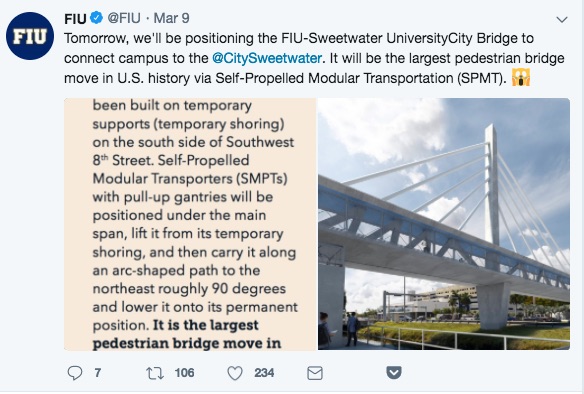
The university hyped the bridge's green engineering.
"The new bridge is the first in the world to be constructed entirely of self-cleaning concrete," a university description of the project explained. "Titanium dioxide will keep its surface white, remove pollutants from the air, and decompose UV radiation. The titanium dioxide, when exposed to sunlight, captures the pollutant particles from the air and self-cleans its own concrete surfaces. This reduces maintenance. This self-cleaning concrete is considered a promising tool for reducing pollutant load on heavily congested traffic routes.
"Eco-friendly LEDs will 'paint' the pylon and pipe supports in programmable colors," it continued. "The pylon is capped with a beacon of light."
The university reports that the bridge was "the largest pedestrian bridge moved via Self-Propelled Modular Transportation in U.S. history."
The funds for the project came from a federal grant secured by Rep. Mario-Diaz Balart through his position on the House Appropriations Subcommittee on Transportation, Housing and Urban Development.
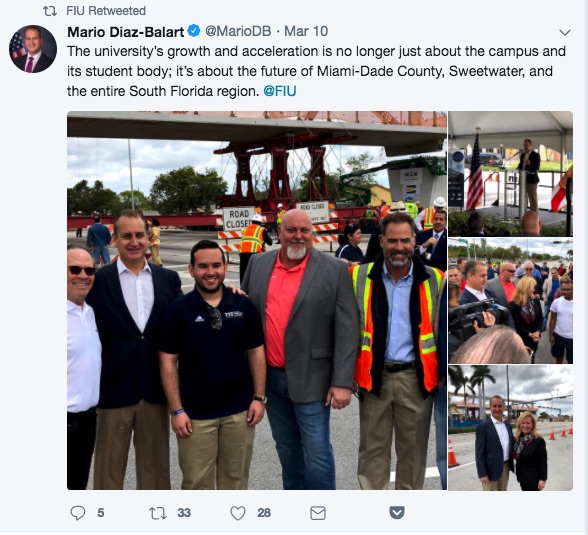
“FIU has come a long way since the TIGER grant that funded this pedestrian bridge was awarded in 2013," Diaz said Saturday. “The university’s growth and acceleration is no longer just about the campus and its student body; it’s about the future of Sweetwater, Miami-Dade County and the entire South Florida region. I believe this is what creative solutions to transportation challenges look like, and I will continue to support and incentivize these new ideas.”
The TIGER program was started as part of the Obama Administration's stimulus program and has come under attack for overweighing social objectives like sustainability at the expense of safety and engineering design. Reason reports:
DOT staff are tasked with evaluating all applications to the TIGER program for how closely they adhere to several “desired long-term transportation outcomes,” including economic competitiveness, state of good repair, livability, environmental sustainability, and safety. Each project is assigned a rating that ranges from acceptable to highly recommended.
In 2014, the GAO released a report that was highly critical of how DOT handled the TIGER V grants, which included money for the FIU pedestrian bridge project. The report said DOT advanced projects with lower technical ratings in lieu of those with higher technical ratings and upgraded the technical rating of 19 projects from acceptable or recommended to highly recommended without documenting a justification. It is unclear from the GAO report whether the FIU bridge project was advanced over more qualified projects or if its technical rating was subsequently upgraded, since the report does not give project-by-project detail.
The project's oversight was conducted by FIGG Bridge Inspection, which is based in Tallahassee. "FIGG, which provides design, engineering and construction services, was cited by the Virginia Department of Labor for four violations in 2012 after a 90-ton piece of concrete fell from a bridge under construction near Norfolk, Virginia," The Miami Herald reports. "The builder did not get the manufacturer's written consent before it modified a girder that ultimately failed, causing the concrete to crash to the ground, according to the Virginia Pilot Ledger."
The $14.2 million bridge was financed from a $19.4 million Transportation Investment Generating Economic Recovery (TIGER) grant from the U.S. Department of Transportation.
FIU claimed the bridge was built to be able to withstand a Category 5 hurricane would last at least 100 years. It remains unclear how the bridge's engineering was so fatally compromised.
